
Subsribe to our email newsletter today to receive update on the latest news, blogs and special offers!


10 September 2023
Edited
17 June 2025
Security officers safeguard properties, individuals and important assets.
Like both the police and emergency medical services (EMS), security guards require specific equipment like protective gear and radios to perform their jobs safely and efficiently.
However, security officers are typically not allowed to carry batons, tasers, or other items considered weapons or firearms.
This security officer equipment list aims to provide an overview of the essential equipment that a security officer in the UK should have.
Uniform and ID for UK Security Officers
Uniform
The uniform is the most immediate identifier of a security officer's role, contributing to both their authority and visibility.
In the UK, the uniform often consists of a shirt with an embroidered badge or company logo, typically worn with tactical trousers. This is often accompanied by a belt to hold essential tools and equipment.
Depending on weather conditions and the job's specific requirements, officers may wear additional items like jackets, fleece pullovers, or caps.

Above: Niton999 Hi-Vis Security Jacket
Uniforms can vary in style and purpose depending on the setting where the security officer works.
For instance, in a corporate environment, the uniform might be more formal, potentially including a tie or blazer, to align with the professional setting.
In contrast, the uniform may be more tactical and rugged for officers working at outdoor events or in high-risk areas, allowing for greater mobility and durability. Hi-vis jackets and vests may also be appropriate.
ID Badge
An ID badge is another fundamental aspect of a security officer's attire. The badge typically features a photograph of the officer, their name, and sometimes a unique identification number.
It may also include the security company's logo and other relevant details, such as clearance levels or areas of responsibility.
The ID badge serves several essential functions:
- Legitimacy: The badge provides immediate legitimacy to the security officer, especially when they may have to interact with the public or law enforcement.
- Accountability: With a clear ID, actions can be attributed to specific officers, which is vital for maintaining professional accountability.
- Security: In sensitive environments, the ID may have electronic features, such as RFID chips, that grant access to restricted areas.
Protective Gear for UK Security Officers
Stab Vest or Body Armor
The nature of the security job often dictates the level of protective gear required. In high-risk situations or settings with a known threat, wearing a stab vest or body armour can be essential for an officer's safety.
While often not as heavy as the ballistic vests used by police, these vests offer significant protection against stabbing weapons.
Boots
Footwear is a frequently overlooked but critical component of a security officer's gear.
The boots should offer a good grip and provide sturdy ankle support to prevent slips, trips, and falls. Depending on the environment, waterproofing may also be an essential feature.
The boots should be comfortable enough to wear for extended periods, as security officers often stand for long hours during their shifts.
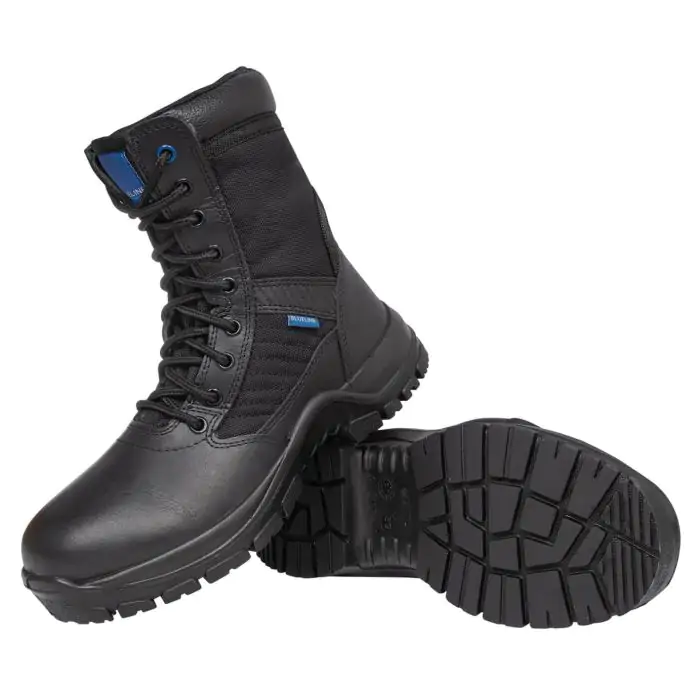
Above: Blueline Patrol Boots
Gloves
Gloves serve multiple purposes in a security officer's gear setup:
- Protection: Gloves protect against various risks, including handling hazardous materials, glass, or sharp objects.
- Intervention: In some instances, officers may have to physically restrain individuals. Gloves can offer protection during such interventions, particularly against bodily fluids.
- Weather: In colder settings, insulated gloves help maintain dexterity, an often underrated but vital aspect of effective security work.
Communication Tools for UK Security Officers
Two-way Radios
Two-way radios serve as the backbone of communication for many security operations.
They provide secure and instantaneous communication between individual officers, teams, and control rooms.
Unlike mobile phones, two-way radios are dedicated communication lines that are generally more reliable in various settings, such as large events or areas with poor mobile phone reception.
These devices are crucial in scenarios that require quick response times, such as emergencies, where a delay of even a few seconds could make a significant difference.
The radios are generally equipped with multiple channels to facilitate communications for different tasks or departments.
For example, one channel might be dedicated to perimeter security, while another could be for internal patrols.
The modern two-way radios used by security officers in the UK often come with various advanced features, including:
- Long-Range Capabilities: For large venues or extensive sites.
- Encryption: To ensure secure communication free from eavesdropping.
- Durability: Designed to be robust and weather-resistant.
Earpiece
Earpieces take the utility of two-way radios a step further by making it possible for officers to communicate discreetly.
This is particularly important when overt communication is distracting or disruptive. For instance, a security officer may need to relay information without drawing attention in a busy retail environment.
There are different types of earpieces suitable for various environments:
- Covert Earpieces: These are designed to be as discreet as possible and are often used in undercover or sensitive operations.
- Acoustic Tube Earpieces: Good for noisy environments, these often include noise-cancelling features.
- Bluetooth Earpieces: These offer more freedom of movement but need to be charged regularly.
Surveillance Equipment for UK Security Officers
CCTV Monitor
CCTV (Closed-Circuit Television) monitoring is essential to modern security operations.
Security officers often have real-time access to multiple camera feeds, allowing them to monitor different areas simultaneously.
This can be particularly crucial for large venues like shopping centres, where constantly patrolling the entire area would be impractical. Real-time CCTV monitoring enables quick identification of suspicious activities, allowing for prompt intervention.
Body Cameras
Body cameras are becoming increasingly common among security officers in the UK. These cameras record audio and video, providing a first-person perspective of incidents.
This can be incredibly useful for legal purposes should any disputes arise regarding an officer's actions. Additionally, the footage can be used for training and performance reviews.
The presence of a body camera can also act as a deterrent against aggressive behaviour, as individuals are generally less likely to engage in unlawful activities if they know they are being recorded.
Essential Equipment for UK Security Officers
Torches
In the context of security work, a torch (flashlight) serves multiple functions beyond simply illuminating dark areas.
It's an invaluable tool for security officers working in the UK, especially for those assigned to night shifts or areas with poor lighting.

Above: Niton999 Professional Original II Torch
Different types of torches serve specific needs:
- LED Torches: These offer high brightness and longer battery life compared to traditional incandescent torches. They are perfect for general patrolling duties.
- Tactical Torches: These are designed for high-stress situations, typically featuring rugged construction and higher light output. They may come with variable settings like adjustable focus, high/low modes, and sometimes even a strobe function. The strobe feature can disorient aggressors, giving the officer crucial seconds to react.
- Headlamps: These are used less commonly but can be invaluable when the security officer needs both hands free for inspections or first aid.
A well-chosen torch should offer a good balance of brightness, battery longevity, and durability. Some advanced models offer USB charging, low battery indicators, and water resistance.
First Aid Kits
The presence of a well-equipped first aid kit is a fundamental requirement for security officers in the UK.
While the officers are not medical professionals, a basic understanding of first aid and the availability of essential supplies can make a significant difference in emergencies.
It enables officers to provide immediate care for minor injuries, which can be especially critical in scenarios where medical professionals may not be readily available.
A standard first aid kit for security officers might contain:
- Bandages: Different sizes and types, such as adhesive bandages for small cuts and larger sterile bandages for more significant injuries.
- Antiseptics: Wipes or solutions to clean wounds and prevent infection.
- Emergency Medication: Aspirin for pain relief, antihistamines for allergic reactions, etc.
- Gloves: Nitrile or latex gloves for hygiene and protection when administering first aid.
- Tweezers and Scissors: For removing splinters or cutting bandages and tape.
- Resuscitation Mask: For CPR, to protect the first aider and the patient.
- Burn Gel: For minor burns.
- Eye Wash: In case something harmful gets into the eyes.
Given the potential physical risks associated with security work, such as confrontations or accidents, having a first aid kit readily accessible is not just advisable but essential.
Security officers should also undergo basic first-aid training to use these supplies effectively.
The kit should be regularly inspected and replenished to ensure it's ready for use when needed.
Security officers significantly improve their preparedness for various challenges that may arise during their duties by having a reliable torch and a comprehensive first aid kit.
Summary
This security officer equipment list offers a spectrum of equipment to make life easier for security personnel.
Being safe, secure and comfortable is essential – and equipment plays a massive role here.
The Niton999 shop provides everything security officers need to thrive in the field, including uniform, safety gear, first-aid, technology and more.
FAQs
What equipment a security officer may need when patrolling?
When considering equipment for security officers, it’s typically recommended to have a two-way radio, torch, protective gear like a stab vest or body armour, and access to a first aid kit. This is the bare minimum.
What are the 4 types of patrolling security?
The four main types of patrolling are:
- Foot Patrol: Officers patrol on foot, allowing for greater interaction and more detailed observation.
- Vehicle Patrol: Covers larger areas, useful for quick response.
- Bicycle Patrol: Provides mobility and is eco-friendly.
- Segway Patrol: Used in indoor or smooth outdoor settings, offers a good balance of speed and mobility.
What does a security officer do?
A security officer's primary role is to protect property, assets, and people.
This involves patrolling, surveillance, risk assessment, and sometimes, incident intervention, among other things.
What skills do you need to be a security officer?
Key skills include observation, good communication, physical fitness, problem-solving abilities, and basic first-aid knowledge.


